
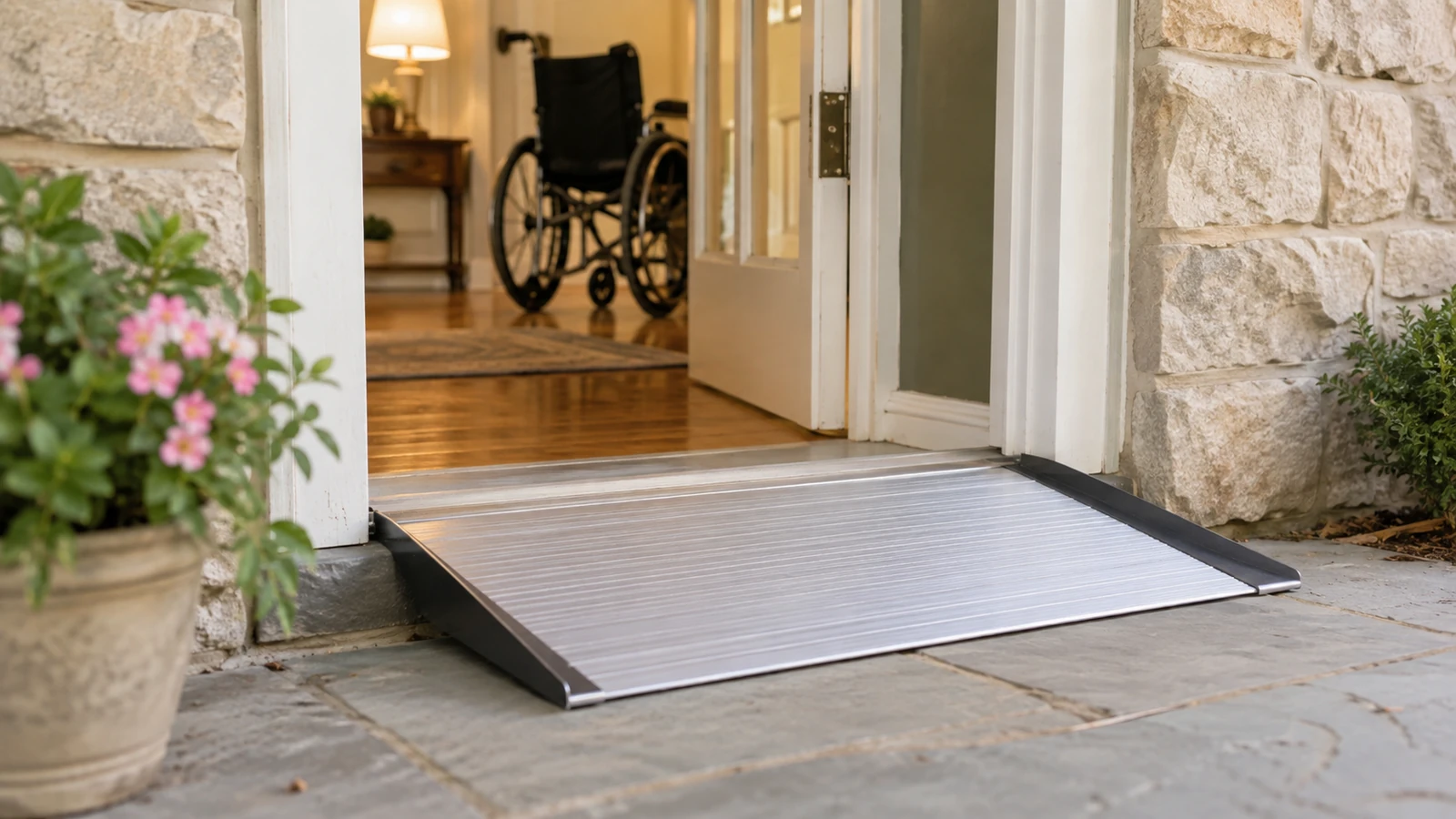
What a threshold ramp does
A threshold ramp is intended for a relatively small vertical change where a full ramp system may not be necessary. Common examples include an exterior door sill, garage entry, or the track of a sliding door.
The key is to solve the transition without creating a steep wedge that is difficult to climb or descend.
Measure the rise first
Measure from the lower finished surface to the top of the level that must be reached. Then measure how much horizontal space is available for the ramp.
A short ramp over a tall threshold becomes steep quickly. Do not select only by the product's advertised height; confirm the actual slope and manufacturer guidance.
ADA slope as a planning reference
On ADA-covered accessible routes, ramps generally cannot be steeper than 1:12, meaning one unit of rise for twelve units of run, with detailed requirements for width, landings, handrails, surfaces, and edge protection depending on the ramp.
That is a valuable accessibility reference, not an automatic rule for every private-home threshold ramp. The safest residential slope may need to be gentler depending on the user and device.
Portable versus fixed
Portable rubber or aluminum threshold ramps can be convenient when the rise is small and the surface is appropriate. Fixed or modular systems can provide more stability and can be integrated with a landing.
A portable ramp that slides during use is not a safe solution. Follow the manufacturer's anchoring or anti-slip instructions.
Door operation
A ramp must not prevent the door from opening, interfere with weather seals, or create a pinch point. Sliding-door tracks sometimes require solutions on both sides of the track.
Check whether the user can approach the handle, open the door, move onto the ramp, and close the door without rolling backward or losing balance.
Weather and drainage
Exterior threshold ramps need traction in rain and should not trap water against the building. Snow and ice can make a small ramp much harder to use.
Drainage, frost movement, and material durability should be considered before installation.
Quick Reference
| Factor | Check before buying |
|---|---|
| Rise | Exact vertical height to overcome |
| Run | Available horizontal space |
| Surface | Firm, stable, slip-resistant |
| Door | Full opening and weather-seal function |
| Landing | Enough space before/after transition |
| Weather | Drainage, rain, snow, ice, UV exposure |
| Device | Walker, manual chair, power chair, scooter needs |
Measure the height difference where you actually roll or step
A threshold can include more than one rise: the floor may slope toward the doorway, the door sill may be raised, and the exterior surface may sit lower. Measure the full change along the route rather than estimating from one edge.
Use those measurements to compare ramp options and to understand whether the transition can be handled with a small threshold product or needs a longer approach.
Check how the ramp changes the door
A ramp placed too close to a swinging door can interfere with the door edge, weather seal, or the space needed to stand while opening it. Exterior doors also need water kept outside the building.
Open and close the door through its full range before choosing a ramp. Make sure the proposed solution does not block drainage or create a new trip edge.
Choose portable products only when they can stay stable
A portable threshold ramp can be useful for temporary needs or occasional access, but it still needs a stable, level position. A product that shifts each time it is crossed can create a different problem.
Follow the manufacturer’s setup limits and weight ratings. Do not improvise with loose boards or stacked materials.
Keep exterior ramps clear and maintained
Leaves, dirt, algae, snow, and ice can change traction. A small ramp at an exterior door may also collect water if drainage is poor.
Include the ramp in normal entry maintenance. Check for movement, worn traction surfaces, loose fasteners, and changes in the surrounding pavement.
Choose the change that improves a real route
You do not need to redesign the entire home because one path has become awkward. Start with the route that affects your day most often. Remove movable obstacles, improve lighting, change storage, or adjust furniture before assuming construction is necessary.
If a larger change is needed, define what should be easier after the project. That makes it easier to compare a ramp, lift, doorway change, first-floor arrangement, or another option based on the way you actually use the home.
Test the route during a normal day
A route can pass a daytime walkthrough and still feel different when the house is busy. Doors are open, laundry is waiting, packages arrive, pets move through the room, and lighting changes after sunset. Use the route under the conditions that normally make it busiest.
Notice where you hesitate, back up, turn sideways, or reach for furniture. Those moments give you more useful information than a measurement alone and help you choose a change that fits real life.
Keep the solution simple enough to maintain
Any ramp, lift, rail, door change, or rearranged space will need cleaning, inspection, adjustment, or repair. Ask who will maintain the change and how you will know when something needs attention. A complicated solution can become a new burden if nobody understands it.
When two options solve the same problem, consider the one that still works during a power outage, busy week, or temporary change in routine. Simplicity can be an important part of independence.
Use qualified help for structural changes
Door widening, ramps, stair work, rail installation, wall changes, and electrical modifications can affect structure, weather protection, building requirements, and other systems in the home. A good idea still needs to be installed correctly.
Describe the exact route problem to the professional and ask how the proposed work changes the approach, landing, door operation, drainage, lighting, and surrounding space. This keeps the project focused on daily use rather than only on the product being installed.
Review the result after you have lived with it
Use the changed route for several days before deciding the work is finished. A moved table, different door swing, new ramp, or added rail can solve one problem while changing how another person moves through the same space. Check the route in both directions and at different times of day.
If the original difficulty remains, write down the exact moment that still feels awkward. That information is far more useful for the next adjustment than simply deciding that the first change did not work.
Sources
Frequently Asked Questions
What is a threshold ramp used for?
It bridges a small change in level such as a doorway sill or short step.
Is a 1:12 slope required at my house?
ADA uses 1:12 as the maximum ramp slope on covered accessible routes, but private residential requirements vary. It is still a useful design reference.
Can a threshold ramp be portable?
Yes, if the product is intended for that use and remains stable during use.
Can I put a ramp over a sliding-door track?
Some products are designed for this, sometimes using an inside and outside piece. Confirm door operation and product compatibility.
What is the biggest mistake?
Using a ramp that is too steep or unstable because only the threshold height was considered.
Keep this visual on Pinterest
Save the infographic so you can return to the checklist or comparison when you need it.
 Save on Pinterest