Frequency is the first decision
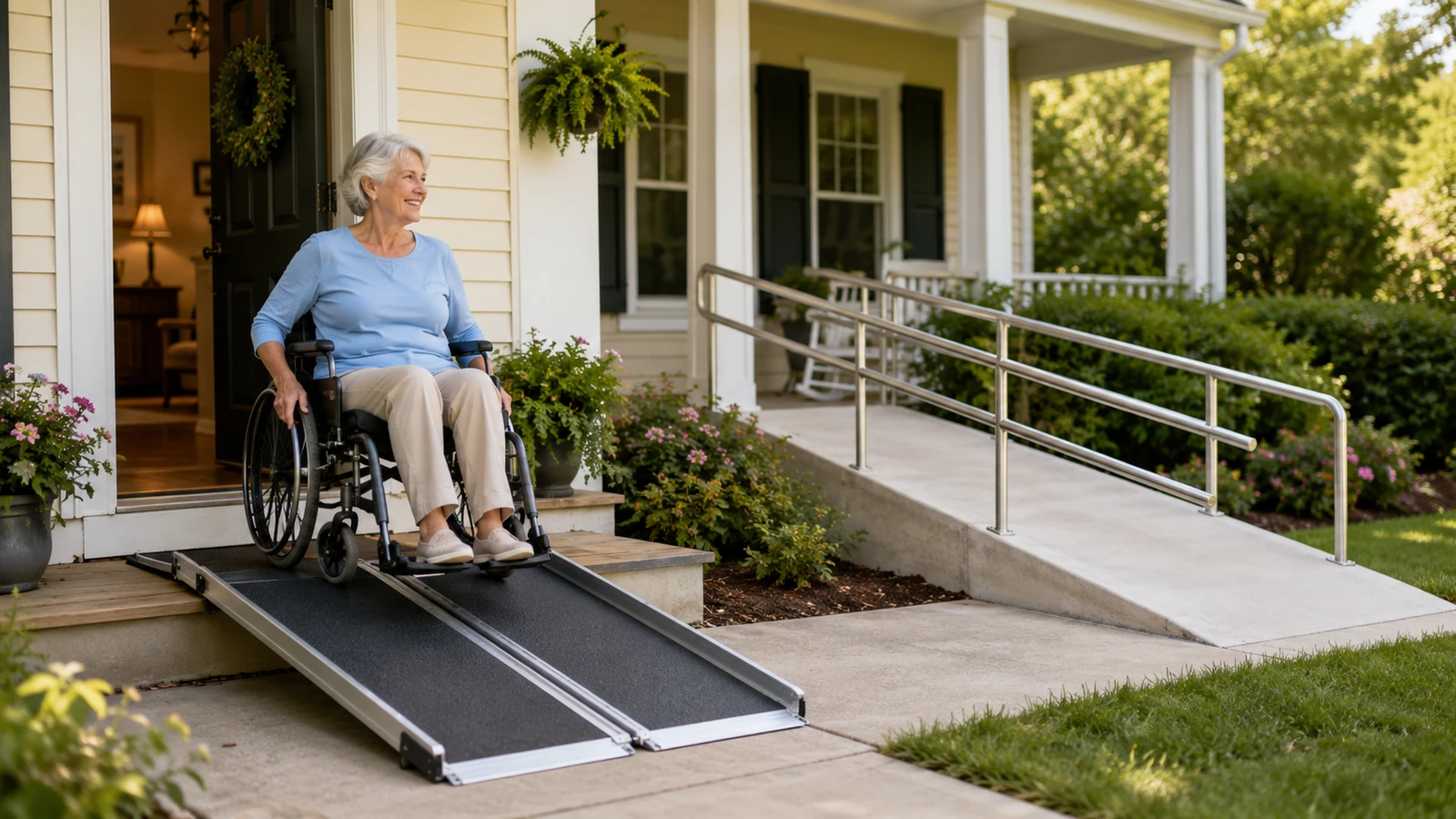
If a ramp is used several times every day, repeated setup can become inconvenient and inconsistent. A permanent system may provide more predictable access.
Portable ramps can be valuable for travel, temporary recovery, visiting another home, or a very small transition, but they must be handled and placed correctly every time.
Slope and length
The higher the rise, the longer a comfortable ramp becomes. ADA standards use a maximum 1:12 running slope for most new ramps on covered accessible routes and require level landings, with additional requirements based on the configuration.
Even when those standards do not legally apply to a private house, they demonstrate an important principle: steep ramps save space by making the route harder.
Landings matter
The top of a ramp often meets a door. The user may need to stop on a level surface, reach the hardware, open the door, and maneuver through.
The U.S. Access Board notes that level landings are needed at accessible doors so users can maneuver while operating the door. A ramp that ends directly at a difficult door can fail even if the ramp itself is usable.
Handrails and edges
Depending on rise and design, permanent ramps may need handrails and edge protection. Even when not legally required at a private home, those features may improve confidence or prevent wheels from slipping off an edge.
Portable ramps often have raised edges but not handrails, which may make them less suitable for people walking with balance concerns.
Weather and maintenance
A permanent exterior ramp must handle rain, leaves, snow, ice, drainage, and long-term material wear. Wood requires maintenance; metal can become hot or icy; composite and modular materials have their own requirements.
A portable ramp must be stored somewhere dry and accessible without creating a heavy lifting task.
Cost and future use
A portable ramp generally requires less construction, while a permanent ramp may involve footings, permits, railings, landscaping, or porch modifications.
Before investing in a long ramp, also consider whether another entrance, a platform lift, or a different first-floor route would solve the problem with less space.
Quick Reference
| Factor | Portable ramp | Permanent/modular ramp |
|---|---|---|
| Use | Occasional/temporary | Frequent/daily |
| Setup | Must be positioned each use | Always ready |
| Length | Limited by transport/storage | Can support longer runs |
| Landings | Often separate issue | Can be integrated |
| Handrails | Often absent | Can be designed in |
| Weather | Stored between uses or exposed temporarily | Must withstand ongoing exposure |
| Construction | Minimal | May require permits/site work |
Decide how often the ramp will be used
A portable ramp may make sense for occasional visitors, recovery from surgery, or a route that is used only sometimes. A permanent ramp is usually easier to integrate when the route is needed every day.
Think about setup effort too. A portable ramp is not convenient if someone must carry, position, and secure a heavy piece every time the door is used.
Plan enough room for the needed length
A gentler slope requires more horizontal space. The available yard, porch, driveway, or garage may limit what can be built safely and conveniently.
Do not force a ramp into a space that is too short. A switchback, platform lift, different entrance, or other solution may be more practical.
Treat landings as working space
The top and bottom of a ramp need space to stop, turn, and operate a door. A landing that is too small can make the last part of the route harder than the ramp itself.
Include door swing, rail position, weather exposure, and room for another person when planning the landing.
Compare maintenance and long-term use
Wood, metal, and other ramp materials age differently. Fasteners loosen, surfaces wear, and outdoor conditions can change traction.
Ask how the ramp will be inspected and maintained and who will handle snow, leaves, or repairs. A permanent solution should remain manageable after the installation crew leaves.
Choose the change that improves a real route
You do not need to redesign the entire home because one path has become awkward. Start with the route that affects your day most often. Remove movable obstacles, improve lighting, change storage, or adjust furniture before assuming construction is necessary.
If a larger change is needed, define what should be easier after the project. That makes it easier to compare a ramp, lift, doorway change, first-floor arrangement, or another option based on the way you actually use the home.
Test the route during a normal day
A route can pass a daytime walkthrough and still feel different when the house is busy. Doors are open, laundry is waiting, packages arrive, pets move through the room, and lighting changes after sunset. Use the route under the conditions that normally make it busiest.
Notice where you hesitate, back up, turn sideways, or reach for furniture. Those moments give you more useful information than a measurement alone and help you choose a change that fits real life.
Keep the solution simple enough to maintain
Any ramp, lift, rail, door change, or rearranged space will need cleaning, inspection, adjustment, or repair. Ask who will maintain the change and how you will know when something needs attention. A complicated solution can become a new burden if nobody understands it.
When two options solve the same problem, consider the one that still works during a power outage, busy week, or temporary change in routine. Simplicity can be an important part of independence.
Use qualified help for structural changes
Door widening, ramps, stair work, rail installation, wall changes, and electrical modifications can affect structure, weather protection, building requirements, and other systems in the home. A good idea still needs to be installed correctly.
Describe the exact route problem to the professional and ask how the proposed work changes the approach, landing, door operation, drainage, lighting, and surrounding space. This keeps the project focused on daily use rather than only on the product being installed.
Review the result after you have lived with it
Use the changed route for several days before deciding the work is finished. A moved table, different door swing, new ramp, or added rail can solve one problem while changing how another person moves through the same space. Check the route in both directions and at different times of day.
If the original difficulty remains, write down the exact moment that still feels awkward. That information is far more useful for the next adjustment than simply deciding that the first change did not work.
Sources
Frequently Asked Questions
Is a portable ramp safe for everyday use?
It can be if it is specifically designed, secured, and suitable for the rise, but repeated setup can create inconsistency.
How steep can a permanent ramp be?
For ADA-covered accessible routes, 1:12 is generally the maximum running slope. Private-home requirements vary, and a gentler slope may be more usable.
Do ramps need landings?
Landings are especially important at doors and changes in direction. They provide a level place to stop and maneuver.
Should a ramp have handrails?
Requirements vary, but handrails can be valuable for walkers and some ramp configurations.
What if there is not enough room for a long ramp?
Consider another entrance, a switchback layout, platform lift, or first-floor access strategy.
Keep this visual on Pinterest
Save the infographic so you can return to the checklist or comparison when you need it.
 Save on Pinterest