
Start with the transfer
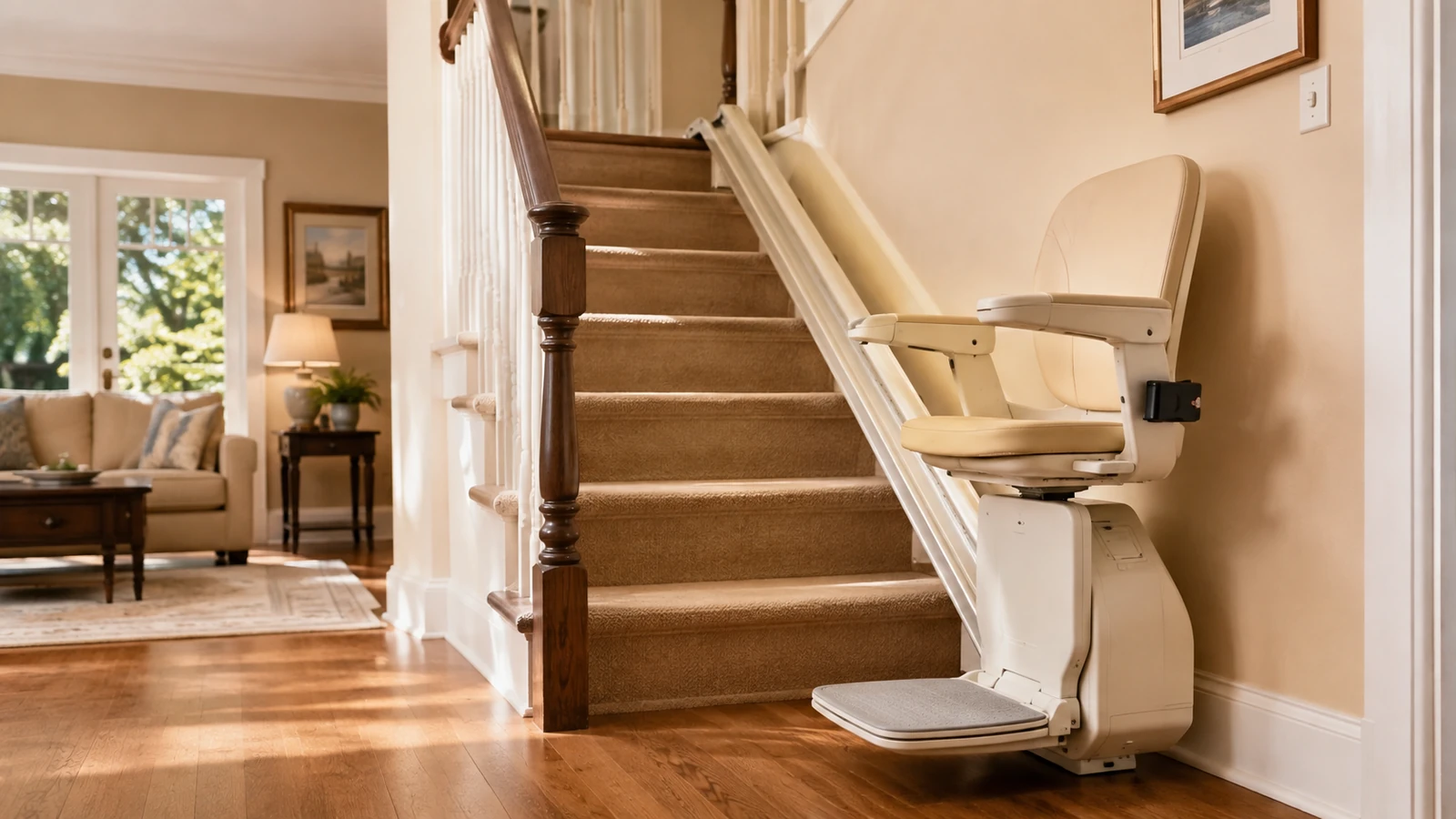
The most important question is not whether the lift can travel up the stairs. It is whether the user can approach the seat, sit, position feet, use the belt, ride comfortably, and stand or transfer at both landings.
The top landing deserves special attention because a poor seat position can place the user close to the stair edge.
Straight versus curved stairs
Straight stair lifts use a relatively simple rail and are typically easier to install. Curved stairs, intermediate landings, or turns require a custom or modular curved rail.
Measure the full staircase, but allow the installer to perform the final survey. Rail geometry, doors, trim, radiators, and walking clearance all affect the installation.
Fold-up components
Many lifts offer folding seats, armrests, and footrests to preserve stair width for other users. Test how much force is required to fold the components and whether they can be operated safely from the needed position.
A narrow staircase may still become difficult for pedestrians after the rail is installed.
Power and battery backup
Many modern stair lifts run from batteries that charge when the unit is parked at designated points. Ask how many trips are possible during a power outage, where the charging points are, and what warning occurs if the chair is not parked correctly.
Battery backup does not eliminate maintenance. Batteries age and eventually require replacement.
Safety features
Look for a seat belt, obstruction sensors, controlled start and stop, swivel or locking seat where appropriate, footrest, and controls that can be operated comfortably.
Safety features vary by model. Read the manual instead of assuming a feature is standard.
Installation and maintenance
Stair-lift rails are commonly mounted to stair treads rather than the wall, but the exact system varies. Installation should follow the manufacturer's requirements.
Ask about service response, annual maintenance recommendations, parts availability, warranty, and what happens if the company stops servicing the model.
Think beyond the lift
A stair lift does not solve carrying a walker, laundry, groceries, or other equipment between floors unless a separate plan exists. It also may not suit someone who cannot transfer onto the seat.
Compare the lift with moving key activities to one floor, adding a second mobility device upstairs, or other access options.
Quick Reference
| Question | Why it matters |
|---|---|
| Can the user transfer at both ends? | The lift only solves stair travel |
| Straight or curved staircase? | Changes rail and installation |
| Where will the chair park? | Affects landing and door clearance |
| What happens in a power outage? | Battery capacity and charging matter |
| Can others still use the stairs? | Rail and folded seat reduce width |
| Who services it? | Reliability depends on future maintenance |
| Can equipment travel too? | Walker/laundry may need separate plan |
Practice the transfer before choosing the chair
A stair lift only helps if you can get onto and off the seat at both ends of the staircase. The seat height, armrests, footrest, and landing space affect that movement.
Ask for a demonstration or assessment that includes the transfer, not just the ride. If standing and turning at the landing are difficult, another arrangement may be needed.
Check what remains of the stair for everyone else
Fold-up seats, arms, and footrests can reduce the space used by the lift, but the rail and equipment still occupy part of the staircase.
Make sure other household members can still use the stairs comfortably and that the equipment does not block a doorway or required path.
Know how the lift behaves during a power outage
Many stair lifts use batteries that charge when the unit is parked, but designs vary. Battery condition and charging location matter.
Ask how many trips the unit is expected to make during an outage, how you will know the battery needs service, and what happens if the lift stops between floors.
Plan service before a breakdown
A stair lift is mechanical equipment and will eventually need maintenance. Service availability can matter as much as the purchase price.
Ask who provides local repairs, typical response times, warranty coverage, and whether replacement parts are readily available. Keep the service number somewhere easy to find.
Choose the change that improves a real route
You do not need to redesign the entire home because one path has become awkward. Start with the route that affects your day most often. Remove movable obstacles, improve lighting, change storage, or adjust furniture before assuming construction is necessary.
If a larger change is needed, define what should be easier after the project. That makes it easier to compare a ramp, lift, doorway change, first-floor arrangement, or another option based on the way you actually use the home.
Test the route during a normal day
A route can pass a daytime walkthrough and still feel different when the house is busy. Doors are open, laundry is waiting, packages arrive, pets move through the room, and lighting changes after sunset. Use the route under the conditions that normally make it busiest.
Notice where you hesitate, back up, turn sideways, or reach for furniture. Those moments give you more useful information than a measurement alone and help you choose a change that fits real life.
Keep the solution simple enough to maintain
Any ramp, lift, rail, door change, or rearranged space will need cleaning, inspection, adjustment, or repair. Ask who will maintain the change and how you will know when something needs attention. A complicated solution can become a new burden if nobody understands it.
When two options solve the same problem, consider the one that still works during a power outage, busy week, or temporary change in routine. Simplicity can be an important part of independence.
Use qualified help for structural changes
Door widening, ramps, stair work, rail installation, wall changes, and electrical modifications can affect structure, weather protection, building requirements, and other systems in the home. A good idea still needs to be installed correctly.
Describe the exact route problem to the professional and ask how the proposed work changes the approach, landing, door operation, drainage, lighting, and surrounding space. This keeps the project focused on daily use rather than only on the product being installed.
Sources
Frequently Asked Questions
Do stair lifts attach to the wall?
Many systems attach the rail to stair treads, but designs vary. Follow the manufacturer's installation method.
Will a stair lift work during a power outage?
Many battery-powered models can make trips during an outage, but capacity and charging behavior vary by model.
Can stair lifts be installed on curved stairs?
Yes, but curved systems require a rail designed for the staircase and are typically more complex.
How much stair width will I lose?
It depends on the rail, seat, footrest, and staircase. Measure remaining pedestrian clearance with components folded.
Is a stair lift the same as a wheelchair lift?
No. A stair lift generally carries a seated person on a chair. A platform lift is designed to carry a wheelchair or scooter with the user.
Keep this visual on Pinterest
Save the infographic so you can return to the checklist or comparison when you need it.
 Save on Pinterest