Start with movement, not a diagram
Before choosing a bar length or height, watch how the bathroom is used. Where does the person pause? Which hand reaches for the wall? Where does weight shift during entry or standing? A useful grab bar sits on that path.
This is why copying a hotel bathroom layout into a private home can fail. The room, dominant hand, fixture location, height, mobility device, and transfer method may be different.
Around the toilet
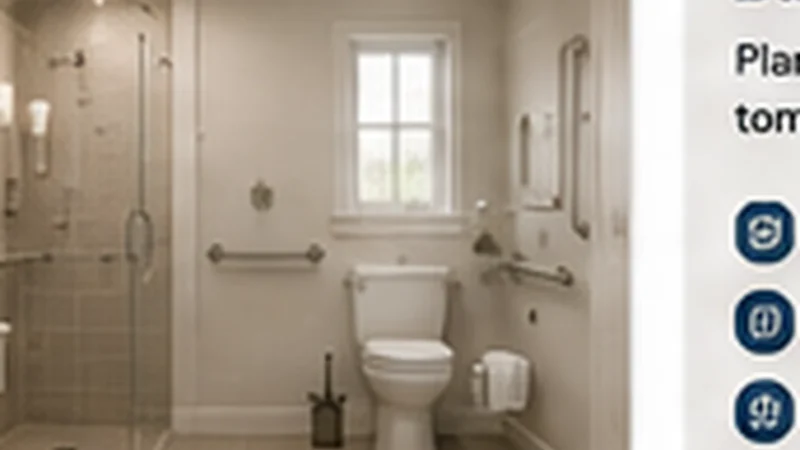
Support may be useful on the side wall, the rear wall, or both. The ADA Standards for covered accessible toilet facilities specify rear and side grab bars and provide detailed dimensions. Those standards are useful references for planning clear space and support, but private residential code may differ.
For a home, focus on whether the person can approach, turn, sit, and stand without twisting toward a towel rack or vanity. If a side wall is too far away, a different support solution may be needed.
In a shower
A shower bar may help at the entry, along the control wall, across the back wall, or near a seat depending on the shower layout. The ADA Standards include different grab-bar configurations for transfer showers, standard roll-in showers, and alternate roll-in showers.
A private home does not need to mimic every ADA configuration to gain useful support. What matters is creating a secure handhold through the movement sequence without blocking a seat, controls, or shower door.
At a bathtub
A tub requires support during a more complex movement: stepping over the side, lowering, turning, and standing. Bars may be placed on the back wall and near the control end depending on the tub and how it is used.
Clamp-on tub rails can appear convenient, but they rely on the tub edge and installation method. CPSC recalled certain multi-grip tub safety bars in 2024 because grip pads could become dislodged, creating a fall hazard. Check recall status and installation requirements for any temporary device.
Horizontal, vertical, or angled?
Horizontal bars provide a consistent height along a wall. Vertical bars can be useful where the hand needs to find support at different heights during entry. Angled bars may follow a movement path, but the correct orientation depends on the user and fixture.
Do not assume one orientation is universally best. If there is a specific mobility limitation, an occupational therapist or other qualified professional can help match placement to the movement.
Wall structure is non-negotiable
A grab bar is only as reliable as its attachment. Tile, drywall, or a decorative wall panel alone does not necessarily provide the needed structural support. Ideally, blocking is installed behind the wall at planned bar locations during construction or remodeling.
Retrofit mounting systems exist, but they must be appropriate for the wall assembly and installed according to their ratings. When in doubt, use a qualified installer.
Quick Reference
| Location | Movement to support | Planning question |
|---|---|---|
| Toilet side | Lowering and standing | Can the user reach the bar without twisting? |
| Toilet rear | Stabilizing/transfer | Does it complement side support and clearance? |
| Shower entry | Step/threshold transition | Where is the hand before the first step? |
| Shower wall | Standing/turning | Can support continue through the bathing area? |
| Tub control end | Entry/exit | Can the user grip before crossing the tub wall? |
Map where your hand goes during each movement
Before choosing a grab-bar location, go through the movement slowly while the area is dry and safe. Notice where your hand naturally reaches when stepping in, turning, lowering to sit, standing, or moving toward the exit.
That natural reach is useful information for the installer. A bar placed several inches away from where you need it may meet a diagram but still be awkward in daily use.
Plan placement before tile and wall work begins
If a bathroom is being remodeled, decide where support may be needed before the walls are closed. Blocking or other structural reinforcement can be added in the correct locations so bars can be securely fastened later.
This can also make future changes easier. You may not need every possible bar today, but planning the wall structure can give you more options later without reopening finished tile.
Keep bars clear and easy to grip
A grab bar loses usefulness when towels, shower caddies, or decorative items cover the gripping surface. The hand should be able to reach it quickly without moving something first.
Choose a finish and shape that feels secure when your hand is wet. Very decorative shapes or oversized rails may be harder to wrap your hand around.
Do not guess about anchoring
A grab bar is intended to support substantial force. Fastening it only to drywall, weak tile backing, or an unknown surface can create false confidence.
Use an installer who understands the wall construction and the product’s fastening requirements. If you do not know what is behind the wall, treat that as something to verify before installation.
Choose the next change around the way you use the bathroom
You do not need every product marketed as accessible or senior-friendly. Choose the change that makes a real part of your daily routine easier, safer, or less tiring. Then use the bathroom normally and decide whether the improvement solved the problem you started with.
When the work involves structural attachment, plumbing, electrical work, waterproofing, major layout changes, or local permit requirements, use qualified help for that part of the project. A clear description of the difficulty will help you ask better questions and compare options.
Before you buy or install anything
Measure the space and write down the exact problem you want the new item to solve. Bathroom products can look compact in a photo and feel very different once they are placed beside a toilet, shower door, vanity, or narrow walkway. Check door swings, drawer openings, shower entry, and the space your feet need while turning.
If the item is intended to support body weight, connect to plumbing or electricity, or become part of a waterproof shower system, make secure installation part of the purchase decision. The product itself is only one part of whether the change will work safely.
Sources
Frequently Asked Questions
What height should bathroom grab bars be?
There is no single private-home height that works for everyone. ADA standards specify heights for covered accessible facilities, but a home installation should also fit the actual user and local requirements.
Can grab bars be installed through tile?
Yes, but the bar must be anchored to adequate structural support or an approved mounting system. Tile itself is not the structural support.
Are suction-cup grab bars safe?
They can lose adhesion and generally should not be treated like permanently mounted structural support. Follow the manufacturer’s limitations and do not assume they carry the same load as a fixed bar.
Can a towel bar be replaced with a grab bar that holds towels?
Yes. Many residential grab bars are designed to look decorative and can serve as a towel-hanging location while still being properly rated and anchored.
Who can help determine placement?
A qualified remodeler can address structure and installation. An occupational therapist can be valuable when placement needs to match a specific transfer or mobility pattern.
Keep this visual on Pinterest
Save the infographic so you can return to the checklist or comparison when you need it.
 Save on Pinterest