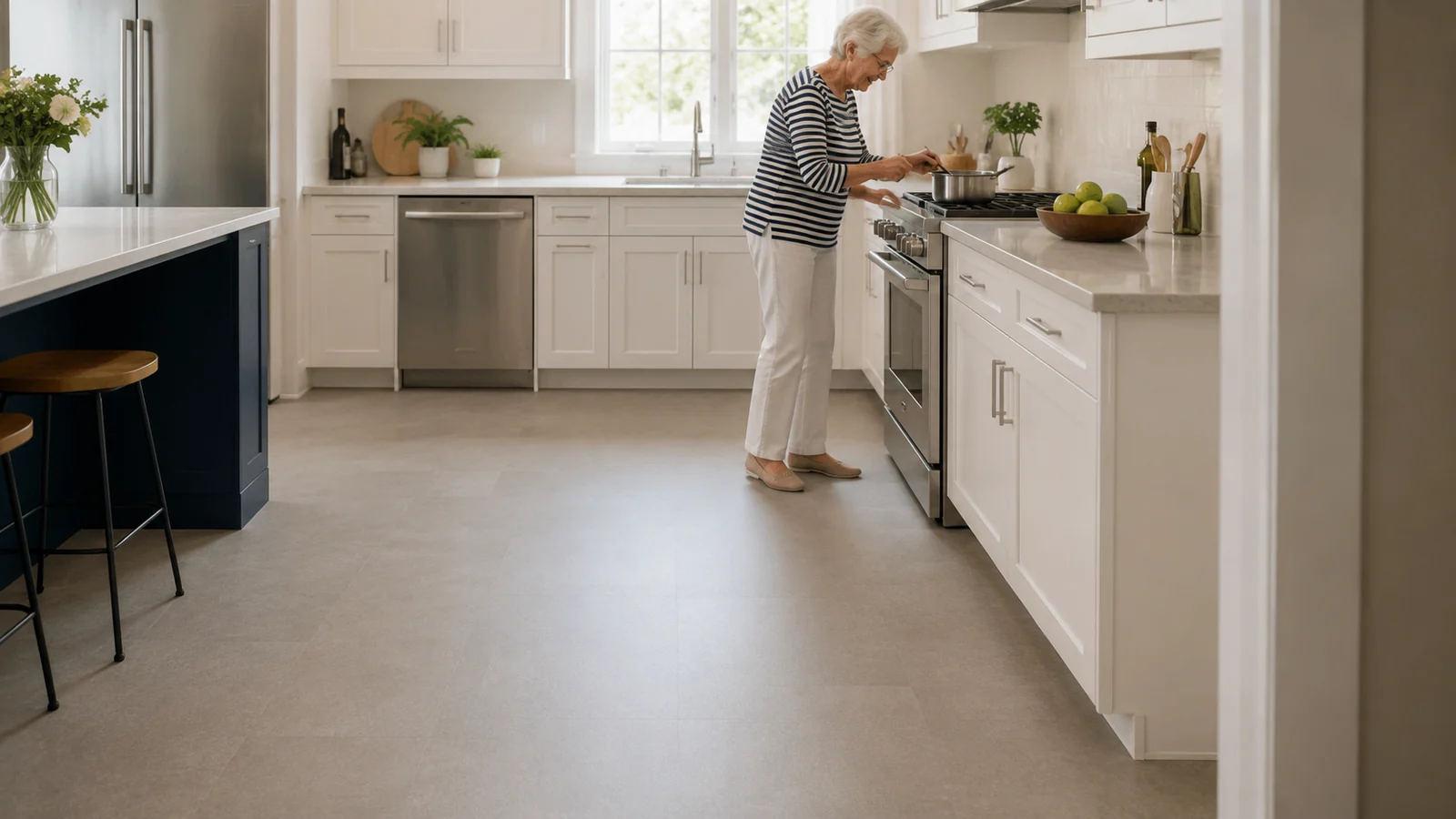
Traction matters in a spill-prone room
Kitchens combine water, grease, dropped food, and frequent turning. A floor that feels secure when dry can behave differently after a spill.
CPSC recommends slip-resistant surfaces and removal of tripping hazards. Look at the exact product’s intended use and maintenance requirements rather than relying on marketing words.
Transitions deserve attention
The edge between kitchen flooring and an adjacent room can create a trip point or impede rolling mobility. Keep thresholds low, visible, and secure.
If new flooring is installed over old flooring, make sure the added height does not create an abrupt lip at doors or appliances.
Resilient flooring
Quality vinyl and other resilient products can provide a slightly softer feel and are available in low-glare textures. Sheet products can reduce seams, while planks or tiles may be easier to repair selectively.
Check wet traction, dent resistance, cleaning requirements, and compatibility with mobility devices.
Cork and rubber
Cork can feel warmer and more forgiving underfoot, while rubber can provide strong traction in appropriate applications. Both require product-specific evaluation for moisture, seams, cleaning, and long-term wear.
A softer surface is useful only if it remains stable and easy to roll across.
Tile and stone
Tile is durable and easy to clean, but hard, glossy surfaces can be slippery and unforgiving. Matte or textured finishes may improve traction.
Grout lines, uneven edges, and cracked tiles can create maintenance issues. Stone performance varies by finish and sealing.
Wood and laminate
Wood can provide a visually warm, relatively smooth surface. Water exposure and finish selection matter in kitchens.
Some laminates can be slippery or damaged by moisture. Verify the exact product’s wet-area suitability and surface performance.
Rugs and mats
A cushioned anti-fatigue mat can make standing more comfortable, but it must lie flat and stay in place. Loose decorative rugs often create more risk than benefit.
If a mat curls, slides, or catches a walker, remove or replace it.
Quick Reference
| Floor factor | Why it matters | What to check |
|---|---|---|
| Wet traction | Spills happen | Manufacturer data / surface texture |
| Transition height | Trip and rolling hazard | Doorways and adjacent flooring |
| Glare | Can hide edges or wet spots | Finish and reflected light |
| Cleanability | Residue can reduce traction | Care requirements |
| Comfort | Long standing can be tiring | Surface resilience |
| Rolling stability | Walkers/carts/wheelchairs | Firmness and seam quality |
Think about spills, not just dry-floor traction
Kitchens regularly see water, grease, crumbs, and dropped food. A surface that feels secure when dry may behave differently when wet or oily.
Ask manufacturers how the product performs in a kitchen and what cleaning products are recommended. Clean spills promptly rather than depending on texture alone.
Keep the path between flooring types smooth
A kitchen often connects to dining rooms, hallways, or living spaces with different flooring. Raised transition strips or uneven edges can catch a foot, cane tip, or wheel.
Include transitions in the flooring plan. A good installation should make the route between rooms predictable, not simply make the kitchen floor attractive.
Balance softness with stability
Some resilient materials feel more comfortable underfoot than hard tile or stone. That can matter when you stand for long periods, but very soft surfaces may behave differently under wheels, heavy appliances, or furniture.
Try samples and ask about indentation, cleaning, and how the material handles chairs and appliance movement.
Use mats only where they stay flat and stable
A cushioned mat can make standing more comfortable, but curled edges or a sliding backing can create another problem.
Choose a mat designed to stay stable on the specific floor beneath it. Keep it out of narrow walkways and replace it when the edges begin to lift.
Choose the next change around the way you actually use the kitchen
You do not need to make the kitchen look different simply because you are over 55. Focus on the repeated task that feels awkward, tiring, hard to see, or difficult to reach. Solve that problem first, then see whether the rest of the room still works well.
If a change involves cabinetry, electrical work, plumbing, structural changes, gas, or another specialized task, use qualified help for that part of the project. A clear explanation of the problem you are trying to solve will make it easier to compare recommendations.
Keep the kitchen easy to maintain
A kitchen improvement should not create a new cleaning or maintenance burden. Pull-outs need to move smoothly, mats need to stay flat, lighting needs reachable controls, and frequently used surfaces should be simple to wipe down. Think about who will clean, repair, or adjust the new feature after the initial installation.
When two options solve the same problem, the one that is easier to understand and maintain may serve you better over time. Convenience only lasts when the feature continues working during ordinary busy weeks.
Make one change before rebuilding the whole room
If the kitchen does not require major construction, try the smallest practical improvement first. Move storage, change a light, add a pull-out, rearrange a work zone, or give a heavy appliance a permanent home. Then use the kitchen for several days and see whether the change solved the problem.
This approach can prevent expensive work from solving the wrong issue. It also gives you clearer information if you later hire a designer or contractor because you can explain what you already tried and what remains difficult.
Ask practical questions before you spend money
When comparing a product or renovation, ask what task it makes easier, what maintenance it requires, how it affects the surrounding space, and whether everyone who uses the kitchen can operate it. A feature is not automatically useful because it is marketed as accessible or senior-friendly.
Measure carefully and compare the full installed cost, especially when work involves cabinetry, electrical changes, plumbing, counters, flooring, or appliance relocation. Use qualified professionals where the project requires specialized work or permits.
Recheck the full kitchen route after the change
Every improvement affects the space around it. A new cart can narrow a walkway. A lowered cabinet can reduce counter clearance. A brighter fixture can create glare on a polished surface. A mat can make standing more comfortable while adding a raised edge near a doorway.
After making a change, walk from the entrance to the refrigerator, sink, cooking area, table, and the storage you use most. Test the route while carrying a plate, a grocery bag, or another item you normally handle. Keep the change if it makes the routine easier without creating a new problem somewhere else.
Sources
Frequently Asked Questions
What is the safest kitchen flooring material?
There is no single safest material. Product-specific wet traction, transitions, maintenance, and installation quality matter more than the category.
Is tile too hard for aging in place?
It can be hard underfoot, but matte textured tile can be durable and stable. Consider comfort, fall impact, and maintenance.
Are kitchen rugs a bad idea?
Loose or curling rugs can be tripping hazards. A mat should remain flat, stable, and out of major rolling paths.
Is cork good for kitchens?
Some cork products can work well, but moisture resistance, sealing, wear, and manufacturer instructions matter.
Should the kitchen floor match adjacent rooms?
A continuous or low-transition surface can reduce trip points, but the exact materials do not need to match visually.
Keep this visual on Pinterest
Save the infographic so you can return to the checklist or comparison when you need it.
 Save on Pinterest