Lever versus knob controls
A single lever can reduce the twisting required by separate round knobs and makes one-handed operation possible. Large handles are also easier to identify quickly.
The lever should move smoothly without requiring excessive force.
Touchless faucets
Touchless or touch-activated faucets can be useful when hands are full or gripping is uncomfortable. But every electronic faucet needs a clear fallback: battery replacement, manual override, or operation during a power failure depending on the model.
Ask how the faucet behaves when the sensor or battery fails.
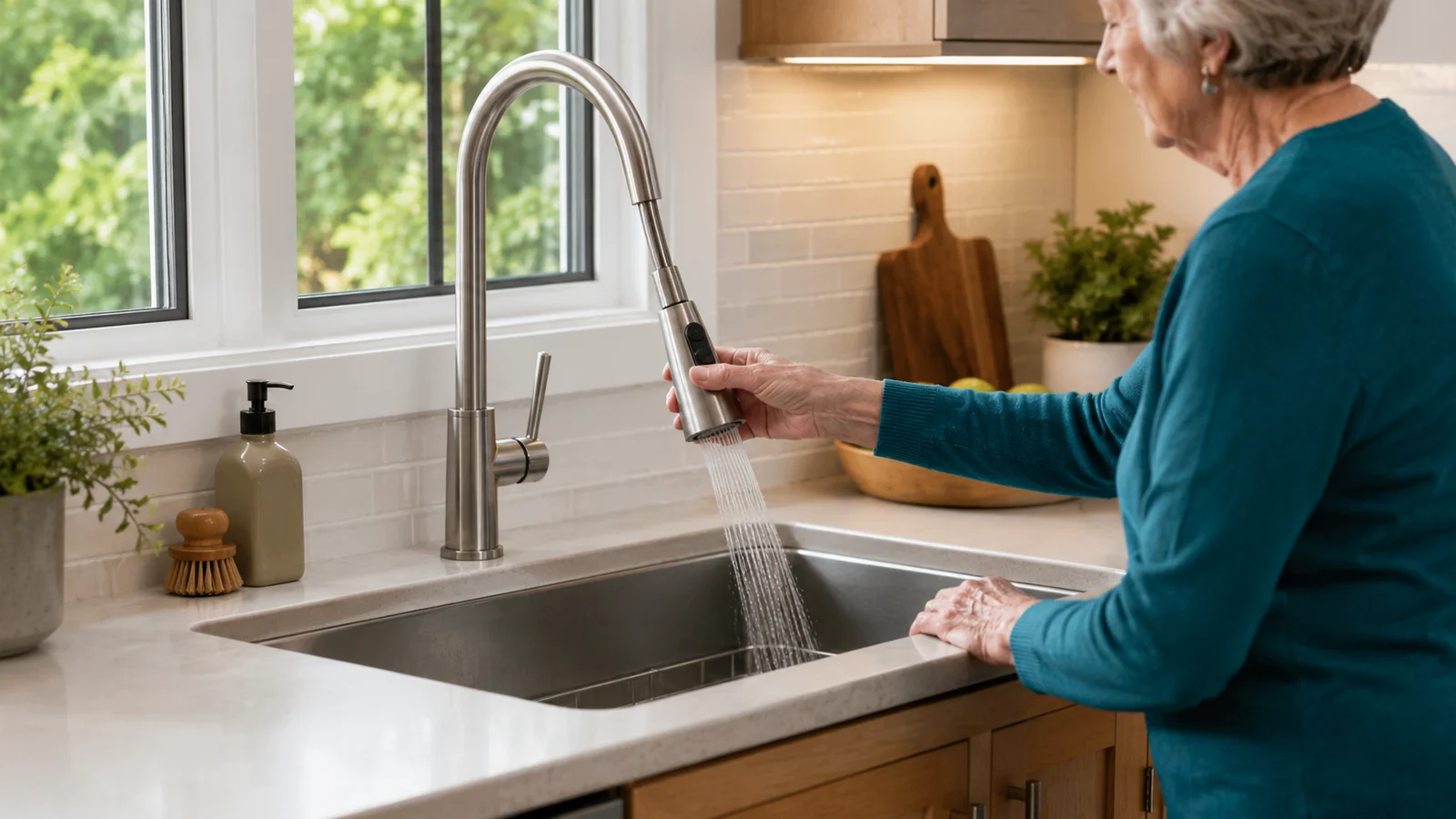
Pull-down spray heads
A pull-down head can bring water to a pot rather than forcing the pot into a fixed stream. Check hose reach, docking strength, spray-button size, and the weight of the head.
A very heavy spray head can become tiring during extended use.
Temperature control
Clear hot/cold markings and predictable lever movement reduce trial and error. Anti-scald or temperature-limiting features may be useful in some households, but configuration should follow the product’s instructions and plumbing requirements.
Do not set or alter safety valves without understanding the system.
Sink depth
A very deep sink provides capacity but can increase forward bending, especially when reaching the bottom. A shallower basin may reduce reach but can splash more.
Choose based on the user’s working height, cookware, and how the sink is used.
Seated access
If seated work is important, knee clearance, plumbing protection, counter height, and clear floor space become part of the sink design. ADA standards provide detailed accessible sink and clear-floor-space references for covered facilities.
For a private kitchen, use those standards as a design reference and coordinate with the user and designer.
Quick Reference
| Feature | Potential benefit | Question to ask |
|---|---|---|
| Single lever | Less twisting; one-handed use | Is motion smooth and clear? |
| Touchless control | Hands-free operation | What happens when power/battery fails? |
| Pull-down spray | Brings water to task | Is the head light and easy to dock? |
| Clear temperature marking | Predictable control | Can hot/cold be identified quickly? |
| Moderate sink depth | Less deep reach | Does it still fit cookware? |
| Seated knee space | Allows seated approach | Are plumbing and clearances protected? |
Choose controls you can operate with a relaxed hand
A faucet should not require a tight grip or repeated twisting. Lever handles, larger controls, and some touch or motion features can reduce effort, but the best choice depends on what feels comfortable to you.
Try the control in a showroom if possible. Make sure you can set temperature and flow without accidentally turning the water too hot.
Put the spray head where you can manage it
Pull-down and pull-out sprayers can make rinsing the sink or filling a pot easier, but a heavy head or stiff hose can be frustrating.
Check how smoothly the hose moves and whether the spray head returns to its dock without extra force. The feature should reduce effort rather than add another awkward movement.
Think about sink depth before replacing the sink
A very deep sink can hold large cookware but may require more bending to reach the bottom. A shallower sink can reduce reach but may splash more easily.
Compare the sink depth with your counter height and the tasks you perform most. There is no single depth that is ideal for everyone.
Keep the area below the sink practical
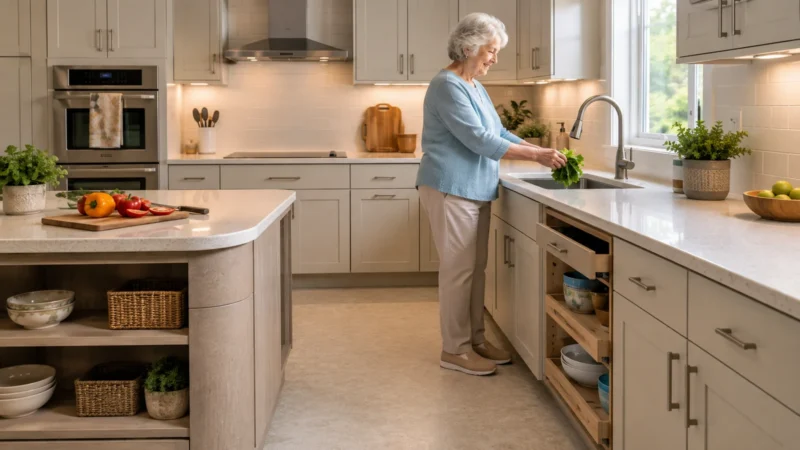
Cleaning supplies, pipes, and garbage systems can make under-sink storage difficult to use. If seated access is important, the plumbing and cabinet design may need special planning.
For ordinary storage, use shallow bins or pull-outs so items do not disappear behind the pipes. Keep chemicals secure and easy to identify.
Choose the next change around the way you actually use the kitchen
You do not need to make the kitchen look different simply because you are over 55. Focus on the repeated task that feels awkward, tiring, hard to see, or difficult to reach. Solve that problem first, then see whether the rest of the room still works well.
If a change involves cabinetry, electrical work, plumbing, structural changes, gas, or another specialized task, use qualified help for that part of the project. A clear explanation of the problem you are trying to solve will make it easier to compare recommendations.
Keep the kitchen easy to maintain
A kitchen improvement should not create a new cleaning or maintenance burden. Pull-outs need to move smoothly, mats need to stay flat, lighting needs reachable controls, and frequently used surfaces should be simple to wipe down. Think about who will clean, repair, or adjust the new feature after the initial installation.
When two options solve the same problem, the one that is easier to understand and maintain may serve you better over time. Convenience only lasts when the feature continues working during ordinary busy weeks.
Make one change before rebuilding the whole room
If the kitchen does not require major construction, try the smallest practical improvement first. Move storage, change a light, add a pull-out, rearrange a work zone, or give a heavy appliance a permanent home. Then use the kitchen for several days and see whether the change solved the problem.
This approach can prevent expensive work from solving the wrong issue. It also gives you clearer information if you later hire a designer or contractor because you can explain what you already tried and what remains difficult.
Ask practical questions before you spend money
When comparing a product or renovation, ask what task it makes easier, what maintenance it requires, how it affects the surrounding space, and whether everyone who uses the kitchen can operate it. A feature is not automatically useful because it is marketed as accessible or senior-friendly.
Measure carefully and compare the full installed cost, especially when work involves cabinetry, electrical changes, plumbing, counters, flooring, or appliance relocation. Use qualified professionals where the project requires specialized work or permits.
Recheck the full kitchen route after the change
Every improvement affects the space around it. A new cart can narrow a walkway. A lowered cabinet can reduce counter clearance. A brighter fixture can create glare on a polished surface. A mat can make standing more comfortable while adding a raised edge near a doorway.
After making a change, walk from the entrance to the refrigerator, sink, cooking area, table, and the storage you use most. Test the route while carrying a plate, a grocery bag, or another item you normally handle. Keep the change if it makes the routine easier without creating a new problem somewhere else.
Sources
Frequently Asked Questions
Are touchless faucets good for older adults?
They can reduce gripping and be convenient, but manual backup and battery/power behavior should be easy to understand.
Is a deep sink better?
Not always. Deep sinks hold large cookware but require farther reaching to the bottom.
What faucet handle is easiest to use?
Single-lever designs are often easier than round knobs because they require less twisting.
Do I need a pull-down sprayer?
No, but it can reduce the need to lift heavy pots toward a fixed faucet.
Can a kitchen sink be designed for seated use?
Yes. Counter height, knee clearance, plumbing protection, faucet reach, and surrounding clear floor space all need to work together.
Keep this visual on Pinterest
Save the infographic so you can return to the checklist or comparison when you need it.
 Save on Pinterest