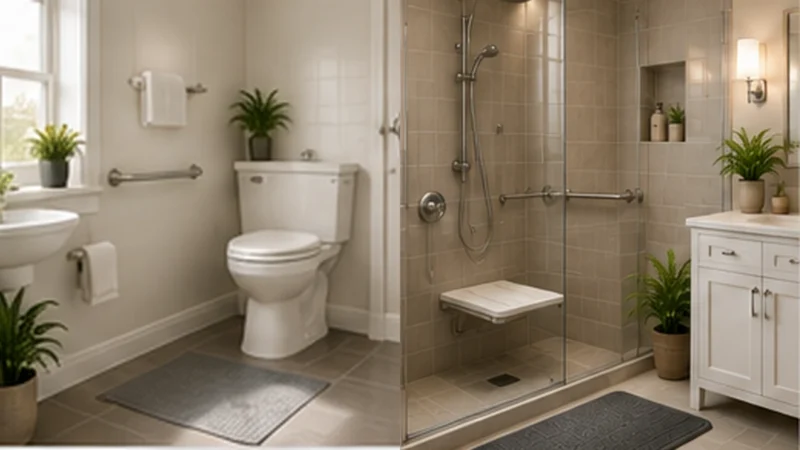
A bathroom should feel private, comfortable, and easy to use. You do not need to make it look clinical to improve safety. Start with the moments that create difficulty now: stepping over the tub, standing for a long shower, getting up from the toilet, reaching a towel, or seeing the floor clearly at night.
What makes a bathroom easier to use?
The strongest bathroom plan begins with the movements that happen every day: entering the room, crossing a potentially damp floor, sitting and standing at the toilet, stepping into or transferring into the bathing area, reaching controls, drying off, and leaving.
A “senior-friendly” bathroom does not need a special style. It needs predictable surfaces, secure support, good visibility, usable reach, enough room for the movement pattern, and fixtures that do not force unnecessary bending, twisting, or high stepping.
Start with traction and support
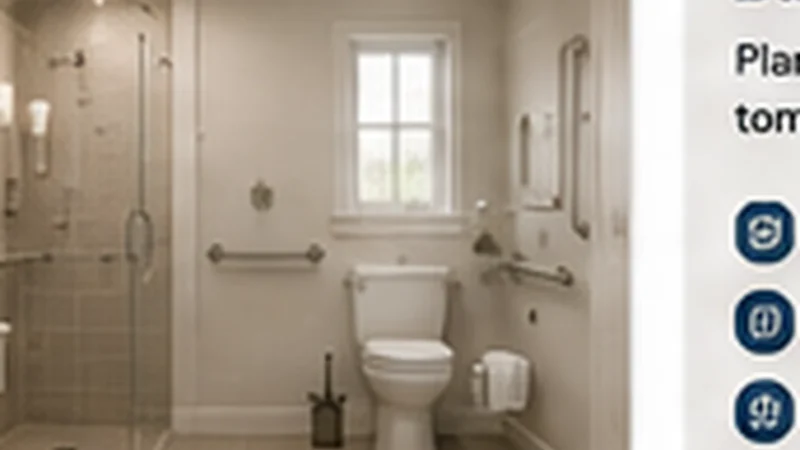
NIA recommends grab bars near toilets and in tubs or showers, along with nonslip strips on surfaces that may get wet. Those are sensible starting points because bathroom tasks combine water with stepping and transfers.
Support must be structural. A towel bar is not a grab bar. A removable device is not automatically equivalent to a permanently mounted support. CPSC has recalled bathroom safety products for instability, so product selection, installation, inspection, and recall checks matter.
Choose the bathing setup around the routine
A conventional tub, low-threshold shower, curbless shower, walk-in tub, transfer bench, or shower chair can each be useful in the right situation. The best choice depends on whether the person stands or sits to bathe, how they cross the entry, how much space is available, and whether future mobility equipment should be accommodated.
Do not choose by product category alone. Think through the whole sequence from dry floor to bathing to exit.
Use ADA information carefully
ADA standards are valuable design references for clearances, grab bars, shower configurations, and accessible water closets in covered settings. But they should not be presented as a universal building code for every private single-family bathroom.
Plan the room as a system
Changing one fixture can affect several others. A taller toilet may change the relationship to a grab bar. A curbless shower can affect floor structure and drainage. A wider doorway may affect switches, framing, plumbing, or the adjacent hall. A bench changes where controls should be placed.
That is why the pillar is organized as a decision system rather than a shopping list.
Start with the way you bathe and use the room
Think through the entire bathroom routine: entering, closing the door, using the toilet, washing at the sink, stepping into the shower or tub, reaching controls, drying off, and leaving. The most useful improvements are the ones that remove difficulty from a real part of that routine.
Notice where you steady yourself, where water reaches the floor, and whether toiletries or towels require awkward reaching. Those observations are more useful than choosing fixtures from a generic accessibility list.
Improve traction without making cleaning impossible
Bathroom flooring needs to handle water, soap, and regular cleaning. A surface that feels secure when dry may behave differently when wet. Very rough surfaces can also become difficult to clean, so balance traction with practical maintenance.
Choose products approved by the manufacturer for the intended wet area. Keep bath mats flat and stable, repair loose flooring, and avoid creating raised edges that become another obstacle.
Put support where movement actually happens
Grab bars are most useful when they match the way you enter, turn, sit, stand, and step. A bar placed simply because a diagram shows a location may not help the person using the room.
Discuss placement before tile or wall work begins so the wall can be reinforced where needed. Never treat a towel bar or decorative accessory as a substitute for a properly anchored support.
Choose a shower or tub around your routine
A low-entry shower can reduce the need to step over a high tub wall. A walk-in tub provides seated bathing but introduces other considerations, including entering before filling and waiting for water to drain before opening the door.
Compare how you prefer to bathe, how much room is available, how quickly you want to enter and exit, cleaning needs, water use, and whether seated bathing is actually useful to you.
Make sitting and standing easier
Toilet height, shower seating, vanity design, and available support can affect how much effort it takes to sit and stand. There is no single height that is ideal for every body or every home.
Choose a toilet or seat height that lets your feet remain well supported and makes standing comfortable. If transfers are difficult, consider the surrounding clear space and support placement rather than focusing on height alone.
Use lighting for both daytime and nighttime
A bathroom needs enough light to see edges, water, controls, labels, and changes in flooring. At night, a softer path light can make the trip from the bedroom easier without flooding the room with glare.
Layer ceiling light, mirror or task light, wet-area light, and a simple nighttime option. Put switches where they can be reached before crossing a dark room.
Plan a remodel in the right order
When a bathroom truly needs major work, start with layout, structure, plumbing, waterproofing, electrical needs, and support locations before choosing finishes. Beautiful tile cannot compensate for an awkward shower entry or a poorly placed control.
Write down the problems you want the remodel to solve. Ask contractors how the plan addresses those problems, and confirm local permit and code requirements for the work being performed.
Take the next step that makes daily life easier
You do not need to change everything at once. Choose one repeated frustration connected with senior-friendly bathrooms, make one practical improvement, and see whether it makes the next week easier. A useful change should reduce effort, confusion, risk, or unnecessary dependence without taking away the parts of your routine you value.
When the issue involves specialized construction, professional services, legal requirements, health questions, or another area where individual circumstances matter, use qualified help for that part of the decision. The purpose of this guidance is to help you notice the right questions and approach the next step with more confidence.